Technology
Revolutionizing thermal management
for AI and semiconductors
Our core innovations — 3DTPEC and ICBO — redefine how heat is managed at the chip and system level.
3DTPEC
3D Two-Phase Enhanced Cooling
3DTPEC leverages advanced phase-change heat transfer within 3D structures to deliver exceptional cooling density and uniform heat removal for next-generation AI and semiconductor workloads. NX Gen Thermal operates under an exclusive sublicense of BlueXthermal’s in-licensed 3DTPEC intellectual property from the University of Virginia, which includes multiple granted patents and a continuing patent family.
Advantages of 3DTPEC
- Patented innovation with proven heat-transfer performance
- Compact form factor with a scalable design
- High resilience for demanding, next-gen computing environments
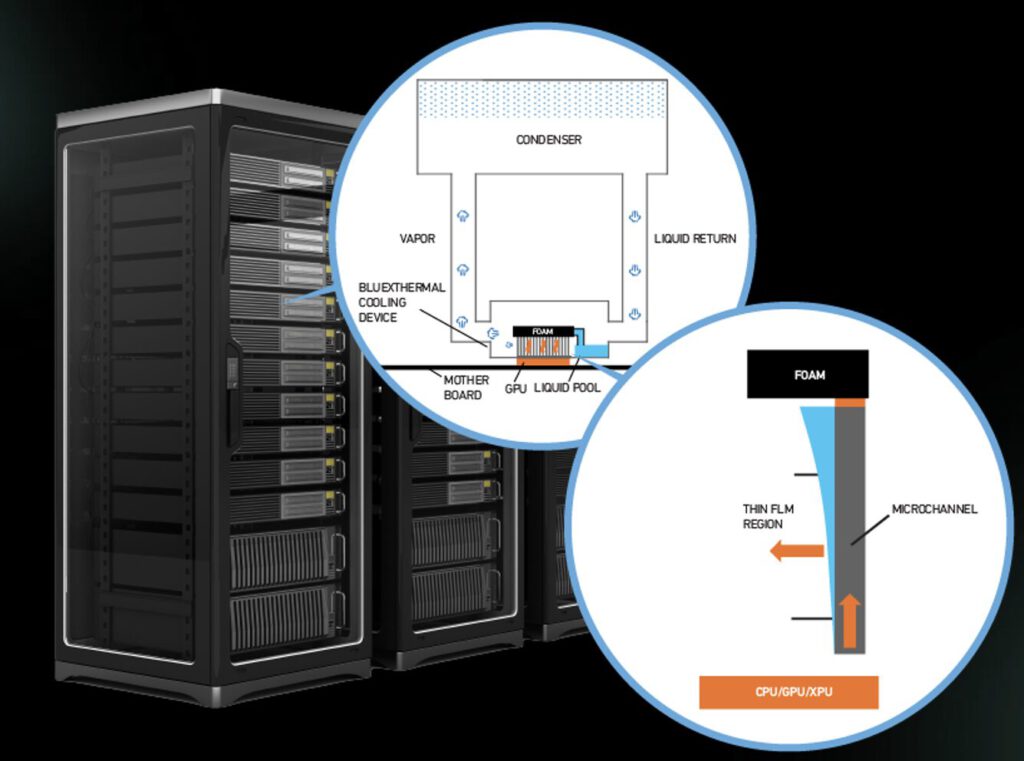
How 3DTPEC Works
3DTPEC (Three-Dimensional Thin-Film Phase-Change Evaporative Cooling) is a high-performance cooling technology that efficiently removes heat from high-power chips such as CPUs, GPUs, and XPUs.
The system uses phase-change evaporation—a process where liquid turns into vapor—to absorb and transport heat away from the chip.
Heat Absorption
A thin layer of liquid coolant comes into contact with a microstructured surface directly above the chip (CPU/GPU/XPU).
As the chip generates heat, the liquid spreads and forms a thin film within the microchannels, supported by a porous foam layer that stabilizes and evenly distributes the coolant.
This thin-film evaporation absorbs a large amount of heat efficiently while maintaining uniform thermal distribution.
Vapor Transport
The generated vapor rises toward the condenser, where it releases the absorbed heat into the surrounding environment (typically through air or another cooling medium).
After releasing heat, the vapor condenses back into liquid form.
Liquid Return
The condensed liquid returns through capillary action within the foam layer or by gravity, completing a self-sustaining closed-loop cycle without the need for mechanical pumps.
This mechanism provides exceptional heat-transfer efficiency with extremely low power consumption.
Summary
3DTPEC’s combination of micro-structured channels and a porous foam layer maximizes surface contact and ensures stable thin-film formation, dramatically increasing thermal performance while keeping a compact device geometry.
It represents an evolutionary leap beyond traditional liquid or immersion cooling—engineered to meet the extreme thermal demands of next-generation AI and high-performance computing systems.
ICBO: Immersion Cooling Bolt-On
Patent pending; developed by BlueXthermal and sublicensed to NX Gen
The Immersion Cooling Bolt-On (ICBO) technology was developed by BlueXthermal (BXT) and is sublicensed to NX Gen Thermal. ICBO delivers ~2–3× performance versus conventional immersion systems, with future die-level integration expected to enable ~4–6× improvements.
Advantages of ICBO
- Superior thermal efficiency
- Reduced operational costs
- Scalable integration for AI-driven workloads
ICBO: Immersion Cooling Bolt-On
Patent pending; developed by BlueXthermal and sublicensed to NX Gen
The Immersion Cooling Bolt-On (ICBO) technology was developed by BlueXthermal (BXT) and is sublicensed to NX Gen Thermal. ICBO delivers ~2–3× performance versus conventional immersion systems, with future die-level integration expected to enable ~4–6× improvements.
Advantages of ICBO
- Superior thermal efficiency
- Reduced operational costs
- Scalable integration for AI-driven workloads
Cooling Method Comparison
| Cooling Method | Method | Key Advantages | Key Disadvantages | Relationship to NX Gen Thermal |
| 3DTPEC (3D Two-Phase Enhanced Cooling) | Patented technology that uses 3D foam and microchannel structures to enhance phase-change heat transfer | – Extremely efficient; supports high power density; compact; patent protected | – Complex to manufacture; high initial cost | Core technology of NX Gen Thermal (under BlueXthermal’s sublicensed patents) |
| ICBO (Immersion Cooling Bolt-On) | Modular system that can be added to existing immersion cooling tanks, with future potential for chip-level (die-level) integration | – Utilizes existing infrastructure; 2–3× current performance, potentially 4–6× in the future | – Requires existing infrastructure (limited standalone capability) | Proprietary technology of NX Gen Thermal |
| Air Cooling (Conventional) | Circulates air through servers using fans | – Low cost; easy to implement with existing infrastructure | – Low cooling efficiency; cannot handle high-density setups; increased power consumption | Not applicable (has reached its physical limits) |
| Liquid Cooling (Direct-to-Chip) | Circulates liquid through cold plates attached directly to CPUs/GPUs | – More efficient than air cooling; compatible with existing racks | – Complex piping/pumps; risk of leakage | Competing technology |
| Immersion Cooling | Submerges entire servers in dielectric liquid | – High cooling efficiency; reduced noise; expanding use in large data centers | – High capital cost; maintenance challenges | Basis for NX Gen Thermal’s ICBO technology |
| Pumped Two-Phase Cooling | Circulates liquid and uses evaporation /condensation for heat transfer | – High cooling efficiency; lower fluid volume required | – Complex pumps/piping; risk of failure | Competing technology |
| Passive Two-Phase Cooling | Uses natural convection for evaporation and condensation without pumps | – Simple and energy-efficient; no moving parts; highly reliable | – Difficult to scale; hard to control | Competing technology |


 info@demo-nx-gen-tharmal.mj-web-connections.jp